Why was he called Popski?
Two names need explaining: how Vladimir Peniakoff became “Popski”, and how a unit officially called No. 1 Demolition Squadron came to be known as Popski’s Private Army.
The short answer
British signallers in the desert couldn’t manage “Peniakoff” over the radio, so they used “Popski” instead, the name of a villain in the Daily Mirror cartoon strip Pip, Squeak and Wilfred. When his new unit was raised in 1942, the staff officer in charge of raiding forces, John Hackett, told him to choose a name quickly or it would be called Popski’s Private Army. Peniakoff took it.
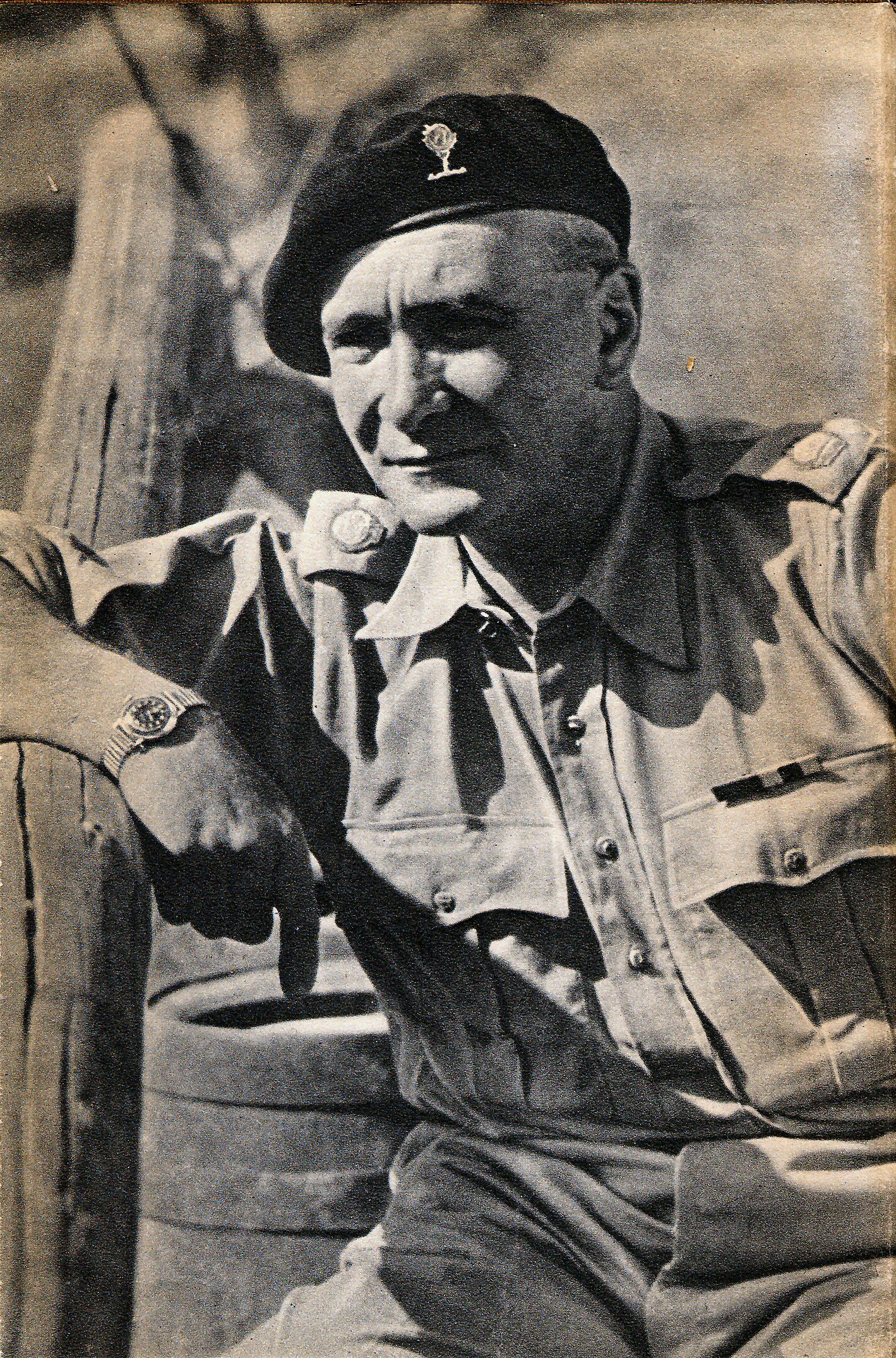
“Popski”
In 1942 Peniakoff was working behind the lines in Libya with the Long Range Desert Group, whose patrols reported by wireless. His surname was long, foreign and easy to garble over a crackling radio link, so the signallers gave him a shorter name.
The name they chose was already familiar to almost every British newspaper reader. Pip, Squeak and Wilfred, a Daily Mirror strip that ran from 1919 to 1956, followed a dog, a penguin and a rabbit, and its recurring villain was a Russian-sounding anarchist called Popski. For a Russian-named officer who jammed the radio net, it fitted.
The cartoon character existed: Popski appears in Pip, Squeak and Wilfred, including the 1921 animated short Popski’s Early Life.
Who first called him Popski?
That isn’t recorded for certain. Wikipedia credits Capt Bill Kennedy Shaw, the LRDG’s intelligence officer, but Kennedy Shaw’s own biography doesn’t mention Peniakoff. Other accounts simply credit “the LRDG New Zealanders”, whose signallers handled much of the wireless traffic.
Peniakoff’s memoir is the only first-hand account of how he got the name. No other source from the time has been found.
“Popski’s Private Army”
When the new unit was raised in Cairo in October 1942, it needed a cover name. Its official title, No. 1 Demolition Squadron, described its task. According to Peniakoff, he was slow to come up with anything, and Lt-Col John Hackett, who ran raiding forces at GHQ Middle East, lost patience:
“You had better find a name quick or we shall call you Popski’s Private Army.”Hackett, as recalled by Peniakoff
Peniakoff said he’d take it. The nickname was meant as a joke at his expense, but the unit adopted it officially and signed itself “No. 1 Demolition Squadron, PPA”. It was probably the only unit in the British Army to put a jibe into its own title.
Hackett’s role in raising the unit is documented independently. The exchange itself comes only from Peniakoff’s memoir. Hackett later wrote the foreword to its second edition (1951), which is the best place to check whether he told the story the same way.
What the name was not
Verified
Verified
Needs verification
Sources
- V. Peniakoff, Private Army (Jonathan Cape, 1950).
- Imperial War Museums, catalogue record for the PPA cap badge, INS 3926, which credits the unit’s name to “a staff officer”.
- On Pip, Squeak and Wilfred: the Daily Mirror strip, 1919–1956.