North Africa, where PPA began
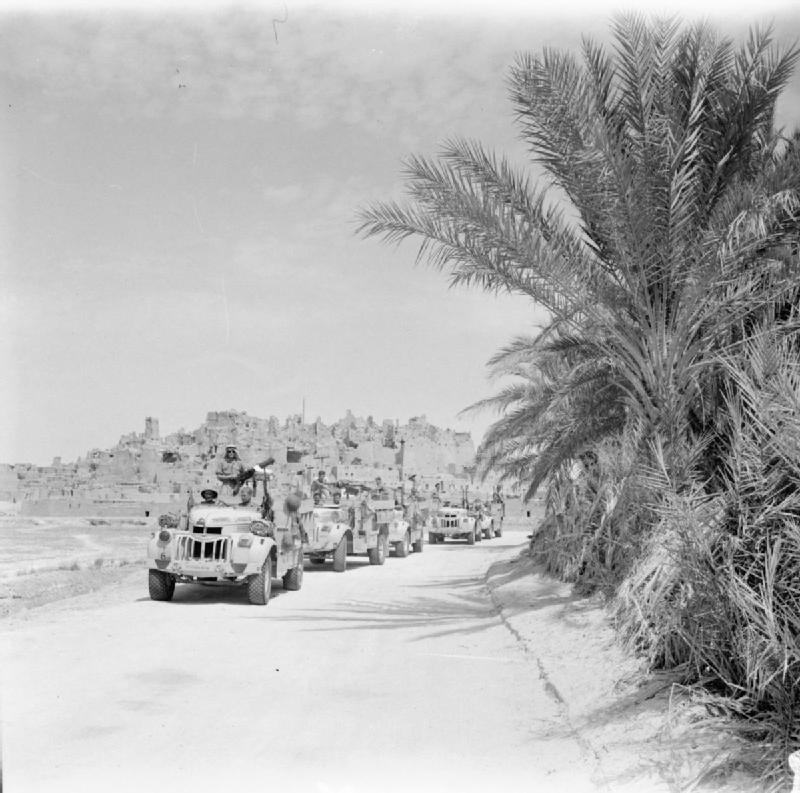
PPA was born in the Libyan desert. Its commander learned the trade leading a small band of Senussi Arab soldiers behind enemy lines in 1942. The unit itself was raised in Cairo that October, set out from the oasis of Kufra, and crossed Libya into Tunisia with the Long Range Desert Group, ending the campaign with the Allied armies at Bizerta.
How did PPA begin?
PPA grew out of the Libyan Arab Force Commando, a unit of about 25 men that Vladimir Peniakoff commanded in the Jebel Akhdar in 1942. After the Barce raid that September, the commando was disbanded and a new, British unit was raised in its place: No. 1 Demolition Squadron, soon known as Popski's Private Army. It became operational at Kufra on 10 December 1942 and fought through Libya and Tunisia until the Axis surrender in May 1943.
North Africa, 1942–43
- 1Jebel Akhdar Apr–Aug 1942
Libyan Arab Force Commando behind the lines - 2Barce (Al Marj) 13/14 Sep 1942
LRDG raid; Peniakoff wounded - 3Cairo Oct 1942
No. 1 Demolition Squadron raised - 4Kufra (Al Kufrah) 10 Dec 1942
PPA becomes operational - 5Zella (Zillah) Late Dec 1942
Moves west with the LRDG - 6Hon (Hun) Late Dec 1942
Forward base - 7Wadi Zemzem Jan 1943
First action - 8Sand sea, west of Mareth Jan 1943
Vehicles lost to air attack - 9Tébessa, Algeria Early 1943
Joins the First Army - 10Gafsa (Qafsah) Spring 1943
Road mining and road watches - 11Matmata Hills Mar 1943
Reconnaissance with the LRDG - 12Bizerta Summer 1943
Joins 1st Airborne Division
Libyan Arab Force Commando, 1942 PPA route, 1942–43 LRDG insertion from Siwa
Approximate route. Modern borders and coastline from Natural Earth (public domain). Map © popskisprivatearmy.com.
The Libyan Arab Force Commando
The Libyan Arab Force was raised in Egypt in August 1940 from Senussi Arabs who had fled Italian rule in Libya. It grew to five battalions, three of which served in the siege of Tobruk in 1941. In March 1942 Peniakoff, then an officer with the force, proposed taking a few of its soldiers behind the Axis lines. He was made a major and given command of a new Libyan Arab Force Commando in May: 22 Senussi soldiers, an Arab officer and a British sergeant.
The LRDG carried the commando into the Jebel Akhdar, the green hill country of eastern Libya, three times between April and August 1942. There Peniakoff watched the coast road, recruited local informers, destroyed a fuel dump and helped British prisoners escape. The best record of what they did is the recommendation for his Military Cross, which survives in full.
Major PENIAKOFF has made three journeys to the JEBEL, being transported on each occasion by the LRDG. On the first trip, between 22/4/42 and 18/5/42, he visited SLONTA, GIOVANNI BERTA and CHAULAN, and established contacts with the local inhabitants to collect information of possible objectives for sabotage. He also carried out a road watch on the MARTUBA road, and reported daily by W/T on enemy traffic.
He again went to the JEBEL on 28/5/42 and remained there until 20/8/42. During this very long stay behind the enemy lines, and in constant danger of being given away by ARABS, he destroyed 50,000 gallons of petrol at GIOVANNI BERTA on 17/8/42, visited DERNA, watched and reported on DERNA L.G. and organised the escape of 5 British P.O.W. from DERNA cage. He also organised an elaborate and successful system of road watching by LIBYAN ARABS and carried out political work among the local inhabitants.
He took part in the LRDG raid on BARCE L.G. on 13/9/42, and was wounded in the subsequent withdrawal.
During all these operations Major PENIAKOFF has shown great courage, and has successfully overcome almost insurmountable difficulties.
The fuel destroyed at Giovanni Berta was 50,000 gallons. The 450,000 often quoted online is a ninefold inflation. See Myths →
The Barce raid
Operation Caravan was an LRDG raid on the Italian airfield and town of Barce, now Al Marj. It was led by Maj John Easonsmith with two LRDG patrols: 47 men in 12 Chevrolet trucks and five jeeps. Peniakoff went with them to handle intelligence, bringing two of his Senussi soldiers.
During the withdrawal Peniakoff stayed at a crossroads with the Guards wireless truck to cover the patrols’ escape, and was hit. One finger of his left hand was amputated in the desert the next day. It was the first of his two wounds; the second, which cost him the whole hand, came in Italy in December 1944.
Peniakoff did not lead the Barce raid, and the raid was in September, not October. His Military Cross was for the whole Jebel period; the raid is only the last line of the recommendation.
A new unit
After Barce the Libyan Arab Force Commando was disbanded, and in October 1942 a new British unit was raised in Cairo in its place, officially No. 1 Demolition Squadron. According to Peniakoff, the name “Popski’s Private Army” came from Lt-Col John Hackett, the staff officer responsible for raiding forces, who told him to find a name quickly or it would be called that. Peniakoff took it, and the unit used it officially.
The naming exchange rests on Peniakoff’s memoir alone. Hackett’s role in raiding forces is independently documented; his words are not.
Establishment and actual strength
The new unit was small even by special-forces standards. The figures below are the official establishment and the men actually available at the start.
| Category | Establishment, Oct 1942 | Actual, Dec 1942 |
|---|---|---|
| Officers | 1 major, 1 captain, 3 lieutenants | Peniakoff, Capt Bob Yunnie, Lt Jean Caneri |
| Other ranks | 18 | RSM Waterson and 12 others |
| Total | 23 all ranks | About 16 |
| Vehicles | 6 | 4 jeeps, 2 three-ton trucks |
In November the unit drove about 700 miles from Cairo to the oasis of Kufra, deep in southern Libya. The journey took eleven days against a planned five. PPA became operational there on 10 December 1942.
Into Tunisia
In late December PPA moved west with the LRDG through the oases of Zella and Hon, and in January 1943 it saw its first action around Wadi Zemzem, inland from Sirte.
Accounts of Wadi Zemzem conflict. One says PPA captured two German armoured cars and disrupted a convoy; another says it met German armoured cars and lost several trucks, a jeep and two men. They may describe the same fight from different sides.
The loss of the vehicles
Also in January, a joint PPA and LRDG patrol set out to reconnoitre the ground west of the German Mareth Line in southern Tunisia. Its vehicles were hidden in the dunes at the edge of the sand sea, but the camp was given away and strafed by German fighters. All the vehicles and stores were destroyed, and the men had to make their way out to Tozeur.
Bob Yunnie’s memoir describes this loss, and Peniakoff’s sharp words to him about it. Peniakoff’s own memoir leaves the episode out. It is one reason this site checks the memoir against other accounts wherever it can.
With the First Army
PPA crossed into Tunisia and attached itself to the British First Army at Tébessa, just over the Algerian border. It was among the first Eighth Army troops to make contact with the First Army and the US II Corps. Around Gafsa it mined a tank bypass on the Gafsa–Kasserine road and kept watch on the roads; PPA reported that about 600 Italians surrendered to it.
In March PPA took part in the LRDG-led reconnaissance of the Matmata Hills ahead of the Eighth Army’s “left hook” round the Mareth Line. After the Axis surrender in May, PPA moved to Bizerta and attached itself to the 1st Airborne Division, which took it to Italy.
Some accounts credit PPA with finding the pass that made the left hook possible. The pass used was Wilder’s Gap, named after Capt Nick Wilder of the LRDG, who found it. PPA’s part in the reconnaissance is confirmed; the claim that it found the route is not.
Wartime and modern place names
Most Libyan places on this page had Italian or anglicised names in 1942. If you are following them on a modern map:
| 1942–43 | Today |
|---|---|
| Barce | Al Marj, Libya |
| Giovanni Berta | Al Qubbah, Libya |
| Derna | Darnah, Libya |
| Jebel Akhdar | Jabal al-Akhdar, Libya |
| Kufra | Al Kufrah, Libya |
| Zella | Zillah, Libya |
| Hon | Hun, Libya |
| Wadi Zemzem | Wadi Zamzam, Libya |
| Tobruk | Tubruq, Libya |
| Benghazi | Banghazi, Libya |
| Gafsa | Qafsah, Tunisia |
What we don’t yet know
- The names of the Senussi soldiers of the Libyan Arab Force Commando, including the two who went to Barce. No source found so far records them.
- What really happened at Wadi Zemzem in January 1943.
- The National Archives references for PPA’s North African war diaries.
If you can help with any of these, get in touch.
Sources
- MC recommendation, Maj V. Peniakoff. The National Archives, WO 373/46/37.
- London Gazette, Supplement 35799, pp. 5141–5142, 24 November 1942.
- V. Peniakoff, Private Army (Jonathan Cape, 1950).
- R. P. Yunnie, Warriors on Wheels (Hutchinson, 1959).