Jeeps, weapons and equipment
PPA fought from jeeps from its first days to its last. Heavily armed and loaded for weeks away from base, they carried the unit across the Libyan desert, through the Apennines and, in 1945, up the Adriatic coast on landing craft.
What did PPA use?
Willys jeeps armed with American Browning machine guns, a .50 and a .30 on each. Some were fitted with searchlights, smoke generators and, in one case, a flamethrower. In the flooded country around Ravenna in 1944 PPA added amphibious DUKWs, and in 1945 it moved its jeeps up the coast in landing craft.
The jeeps
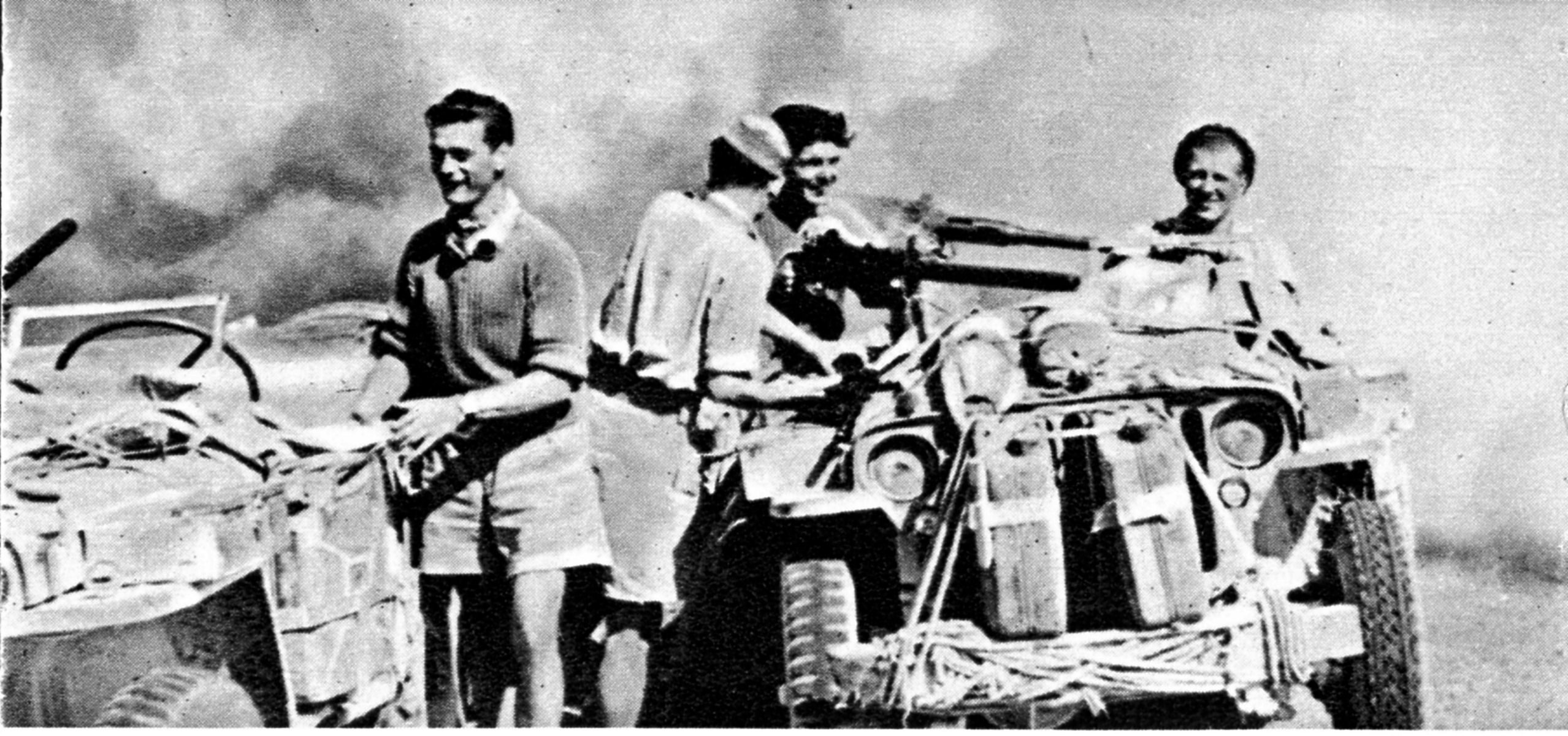
PPA’s fighting vehicle throughout the war was the American quarter-ton jeep. A Royal Engineers officer who carried them north in 1945 described them as Willys jeeps; some may have been the near-identical Ford version.
| When | Vehicles | Status |
|---|---|---|
| Oct 1942 | Establishment of 6 vehicles | Verified |
| Dec 1942 | 4 armed jeeps and 2 three-ton trucks | Verified |
| Sep 1943 | 5 jeeps with the advance party at Taranto | Verified |
| Jun 1944 | 12 jeeps lost when the Astrolabe landing craft ran aground | Verified |
| 1944–45 | Three fighting patrols of 6 jeeps, plus 4 at headquarters | Verified |
| Apr 1945 | 5 jeeps driven round the Piazza San Marco, Venice | Verified |
Modifications
- Machine guns: a .50 and a .30 Browning on each jeep in Italy.
- Searchlights: fitted to some jeeps, shown in the Caneri photographs at the Imperial War Museum.
- A flamethrower jeep: also photographed. It was one of PPA’s most unusual vehicles.
- Smoke generators: carried on the jeeps and used to lay smoke at Camerino in July 1944.
- Range: sand channels, stowage racks and fuel cans for long patrols. Accounts give a range of 600–700 miles.
The range figure and the details of stowage come from secondary accounts. No original PPA jeep is known to survive in any museum.
Weapons
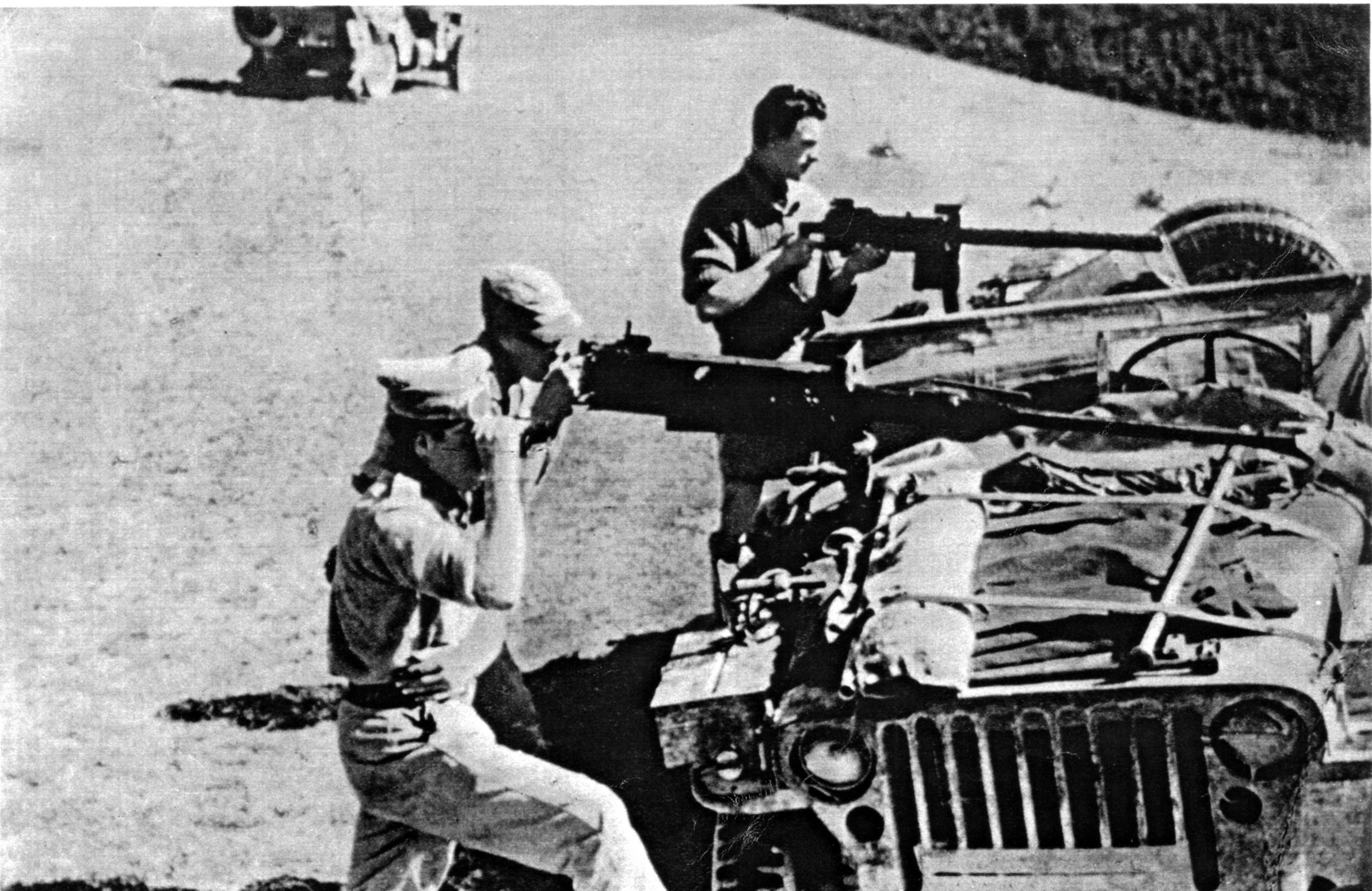
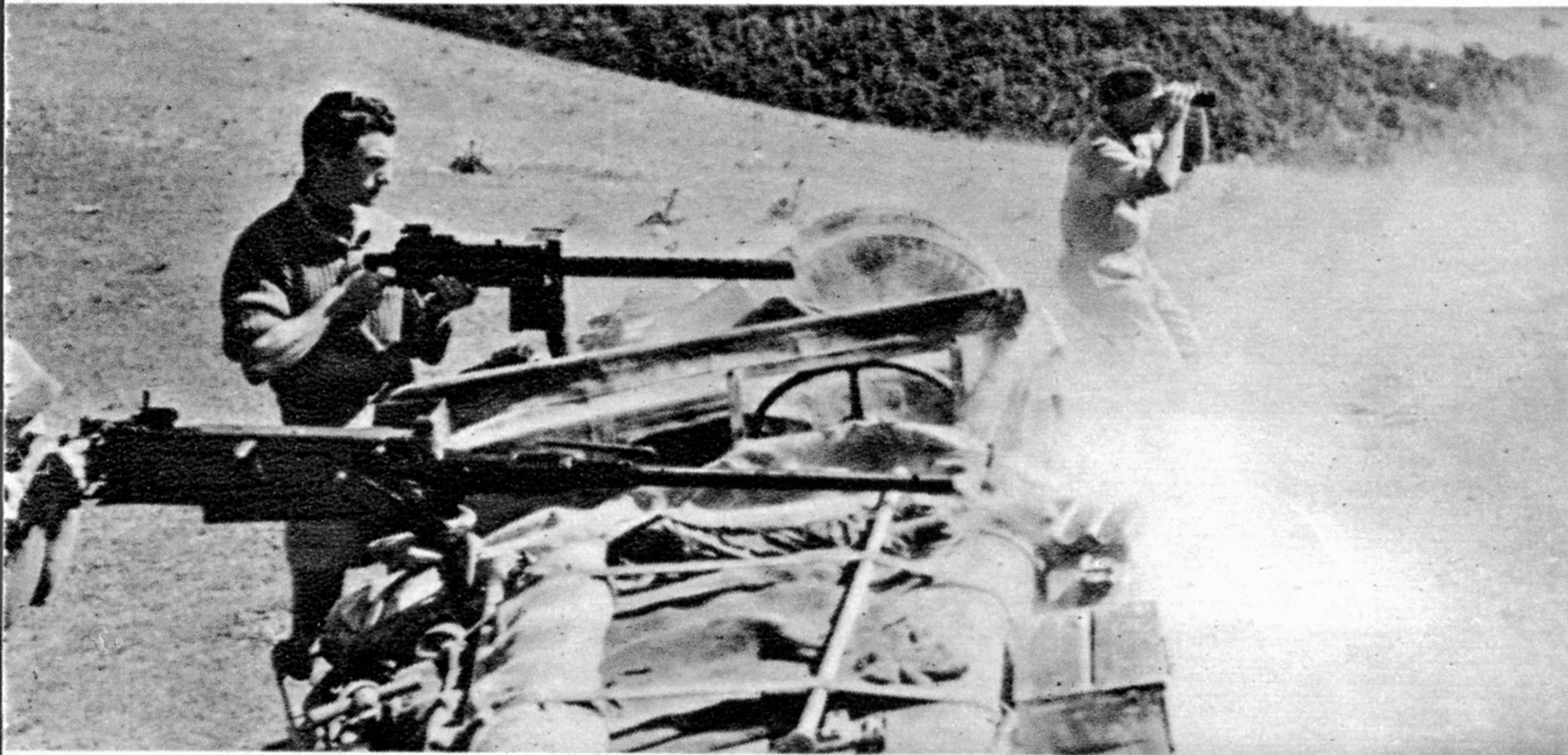
Unlike the LRDG and the SAS, whose jeeps mostly carried British Vickers K guns, PPA in Italy armed its jeeps with American Brownings.
| Weapon | What the records show | Status |
|---|---|---|
| .50 Browning machine gun | One per jeep in Italy | Verified |
| .30 Browning machine gun | One per jeep in Italy | Verified |
| Twin Vickers K | Said to have been fitted to the first jeeps at Kufra, 1942. Not confirmed by a primary source | Needs verification |
| Bazooka | Reported in accounts of PPA’s armament | Needs verification |
| Thompson submachine gun | Carried by individual men; named in Sgt O’Leary’s MM recommendation | Verified |
By water
In October 1944 PPA took on DUKWs, the amphibious lorries known as “Ducks”, to work in the flooded country south of Ravenna. On 1 November they carried the patrols across the flooded Savio, and Peniakoff’s DSO recommendation records that he personally led a DUKW assault patrol.
In April 1945 the jeeps were loaded onto six ramped landing craft and sailed north up the coast with a minesweeper escort. The little flotilla, commanded by Lt E. Thomas, became known as “Popski’s Private Navy”.
Signals and navigation
Wireless was central to PPA’s work from the start. In 1942 Peniakoff’s commando reported enemy traffic on the Martuba road daily by radio. In the desert the unit navigated by sun compass and theodolite, as the LRDG did.
Which radio sets PPA used has not been established. Caneri’s papers at the Imperial War Museum are the most likely place to find out.
How PPA fought
- Small patrols of a few jeeps, working just ahead of the Allied front or behind the German lines.
- Intelligence first: watching roads, finding headquarters and reporting by radio.
- Close work with local people: Senussi informers in Libya, and Italian partisans in the Marche and Romagna.
- Dawn raids on foot on farms and villages, guided by local people.
- Crossing flooded ground by DUKW to appear where the enemy didn’t expect them.
- When needed, holding sections of the front line as ordinary troops.
The unit’s own accounts give large numbers of enemy killed and captured. Most have never been checked independently, so this site gives them as PPA’s claims. Peniakoff’s own tally for the last ten days of the war, 1,335 prisoners and 16 field guns, is the figure most often quoted, and it is quoted correctly.
What we don’t yet know
- The radio sets PPA used.
- Whether any PPA jeep, or part of one, survives.
- How the flamethrower jeep was built and used.
Get in touch if you can help.
Sources
- V. Peniakoff, Private Army (Jonathan Cape, 1950).
- Imperial War Museums, photograph collections 2012-05-71 and 2012-03-15 (catalogue descriptions).
- IWM sound recording 14884, Brian Ewart Thomas, Royal Engineers.
- DSO recommendation, TNA WO 373/11/10; MM recommendation, Sgt W. J. O’Leary.