Who were Popski's Private Army?
Popski's Private Army was the last and smallest of the three irregular units the British Army raised in the North African campaign, after the Long Range Desert Group and the SAS. It gathered intelligence, raided behind the lines and worked with local fighters. Even at its largest it had only about 100 men in the field.
What was PPA?
PPA was a British special-forces unit, officially No. 1 Demolition Squadron, raised in Cairo in October 1942 and disbanded in Austria in September 1945. It was commanded by Lt-Col Vladimir "Popski" Peniakoff and served in Libya, Tunisia, Italy and Austria. It operated in armed jeeps in small patrols, working ahead of the Allied armies, and worked far more closely with local people and partisans than the LRDG or the SAS.
Raised in Cairo
PPA grew out of the Libyan Arab Force Commando, a small band of Senussi soldiers that Peniakoff led behind enemy lines in Libya in 1942. After the Barce raid that September, the commando was disbanded, and in October a new British unit was raised in its place. Its official name, No. 1 Demolition Squadron, was a cover name that described its task. The nickname “Popski’s Private Army” stuck, and the unit adopted it officially.
PPA was an Eighth Army special-forces unit. It relied on the LRDG for transport in the desert, but it was never part of the LRDG: the LRDG’s commander, Lt-Col Guy Prendergast, declined to take it under his command. How PPA began in North Africa →
How big it was
Figures for PPA’s size are often quoted without saying what they measure, which is why they seem to contradict each other. The establishment is the number of men the Army authorised; the actual strength is how many were really there. For PPA the two were rarely the same.
| Date | Measure | Figure | Status |
|---|---|---|---|
| Oct 1942 | Establishment | 23 all ranks: 1 major, 1 captain, 3 lieutenants, 18 other ranks; 6 vehicles | Verified |
| Dec 1942 | Actual strength | About 16, with 4 jeeps and 2 three-ton trucks | Verified |
| Sep 1943 | Actual strength | About 35 all ranks on leaving Africa | Verified |
| Dec 1943 | Establishment | 80 all ranks: 6 officers and 74 other ranks | Verified |
| 1944–45 | Actual strength | About 100 in the field at any one time; the IWM gives “never exceeding 120” | Needs verification |
| 1942–45 | Total who served | 191 men (Whittaker, 1984) | Needs verification |
The officer count at the 80-man establishment is given as five in one source and six in another. The same 1984 source that gives 191 men records 10 killed; Peniakoff’s own Roll of Honour, and the unit memorial, list 12.
The patrols
PPA fought in lettered patrols. In Italy there were three fighting patrols of six jeeps each and a headquarters patrol of four, with each jeep carrying a .50 and a .30 Browning machine gun. The letters were not fixed: ‘B’, ‘R’, ‘S’, an HQ patrol and one called ‘Blitz’ all appear in both Peniakoff’s roll and on the memorial, while an ‘A’ and a ‘P’ Patrol appear once each in other accounts.
Command of the patrols changed often. Capt Bob Yunnie led ‘B’ Patrol for most of the war; ‘S’ Patrol passed from Lt A. A. Reeve-Walker, a South African, to Capt John Campbell in September 1944; and ‘R’ Patrol passed from Maj J. E. W. Rickwood to Sgt E. “Kiwi” Sanders, a New Zealander, and then to Lt G. A. Lee, a Canadian.
Who PPA answered to
Because PPA was so small, it was attached to whichever formation it was working with. It changed hands many times.
| Period | Under command of, or attached to |
|---|---|
| Oct 1942 | Raised under GHQ Middle East, sponsored by Lt-Col John Hackett, GSO1 Raiding Forces |
| Dec 1942 | Eighth Army, as a special-forces unit; the LRDG provided transport |
| Feb 1943 | British First Army and US II Corps, Tunisia, having attached itself at Tébessa |
| Aug–Sep 1943 | 1st Airborne Division, Bizerta and Taranto |
| Autumn 1943 | Eighth Army, in the V Corps sector, alongside 1st Canadian Infantry Division |
| Oct–Dec 1944 | Porterforce, under Lt-Col A. Horsbrugh-Porter, 27th Lancers |
| Early 1945 | The I Canadian Corps area, Romagna |
| May–Sep 1945 | V Corps and British Troops Austria |
How it worked
In 1943 PPA recruited volunteers from the LRDG, the SAS, the Commandos and the Royal Armoured Corps, plus a few men from regimental guardrooms. Peniakoff chose them himself and looked for men who had not fitted in elsewhere. Every recruit gave up his rank: officers dropped to lieutenant, other ranks to private.
1. No saluting.
2. No drill.
3. Officers and men live and mess together.
4. One punishment only: immediate return to your old unit.
Its men came from many places. PPA had a Belgian-born commander of Russian parents, a French second-in-command, South African and Canadian patrol commanders, a New Zealand sergeant from the LRDG, an Italian ex-officer, two escaped Russian prisoners of war, and, in its early days, Senussi soldiers of the Libyan Arab Force.
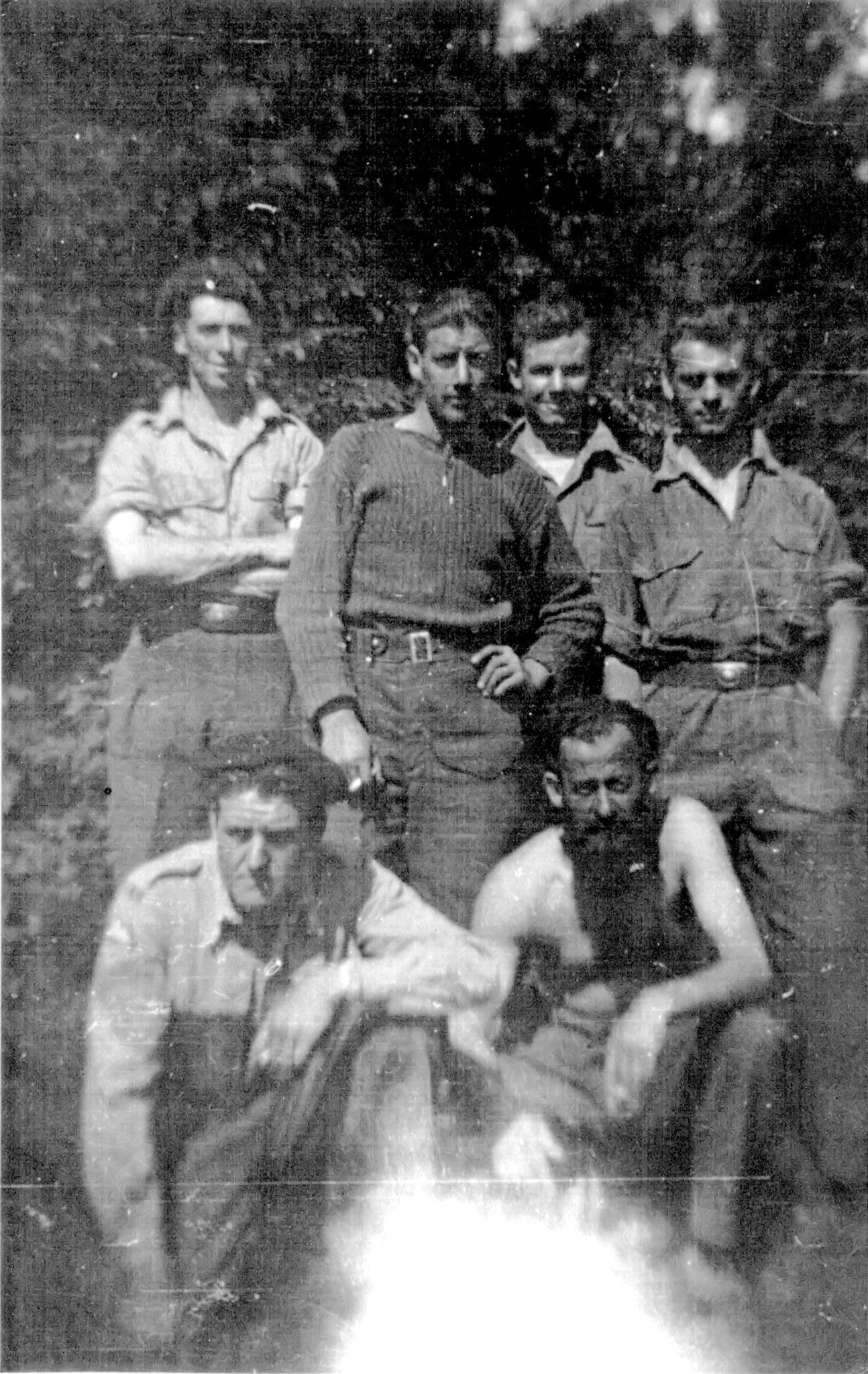
Two details often repeated online, that beards were allowed after five operations and that 130 candidates were interviewed to find 15, come only from an AI-generated page. They may be true, but no reliable source confirms them yet.
PPA, the LRDG and the SAS
PPA is often described as a smaller version of the SAS. It wasn’t. It was closer to an intelligence and liaison unit that happened to have armed jeeps.
| LRDG | SAS | PPA | |
|---|---|---|---|
| Main job | Deep reconnaissance and road watching; carrying other raiders | Raiding, especially airfields | Intelligence, liaison and demolition, close to the front |
| How deep | Hundreds of miles behind the lines | Deep, then out again | Shallow to medium, often just ahead of a friendly formation |
| Vehicles | Chevrolet and Ford trucks, plus jeeps | Jeeps, plus parachute and sea landings | Jeeps, later amphibious DUKWs and landing craft |
| Guns | British: Vickers K, Lewis, Bofors | British: mainly twin Vickers K | American: .50 and .30 Browning |
| Local people | Avoided | Avoided | Central to the method: informers, partisans, surrenders |
| Size | About a regiment | About a brigade by 1945 | About 100 in the field at its largest |
| After the war | Disbanded 1945 | Survives as 22 SAS | Disbanded 1945 |
One thing PPA did that neither of the others ever did: in the summer of 1944, short of men, the Eighth Army used it to hold sections of the front line as ordinary troops.
What PPA was not
Some claims about PPA come up again and again, and none of them is supported by the records:
- Not part of the LRDG. It used LRDG transport, but the LRDG’s commander refused to take it under command.
- Not a Commando unit. Its forerunner was called the Libyan Arab Force Commando, but neither unit was part of the Commando organisation.
- No descent from Middle East Commando. No record connects them.
- No link to the SBS. Its amphibious work in 1944–45 was done with the Royal Navy’s Coastal Forces.
- Never in Greece or the Aegean. That was the LRDG and the SBS.
What we don’t yet know
- The exact number of men who served. Peniakoff’s own index cards, which list every member, are held at the Imperial War Museum and have not yet been studied.
- Whether the ‘A’ and ‘P’ Patrols existed, or are errors in later accounts.
- The National Archives references for PPA’s war diaries.
If you can help with any of these, get in touch.
Sources
- V. Peniakoff, Private Army (Jonathan Cape, 1950), including the roll on p. 501.
- D. Whittaker, Some Talk of Private Armies (1984).
- Popski’s Private Army memorial, National Memorial Arboretum, Alrewas (2008).
- Imperial War Museums catalogue records for PPA collections and oral histories.